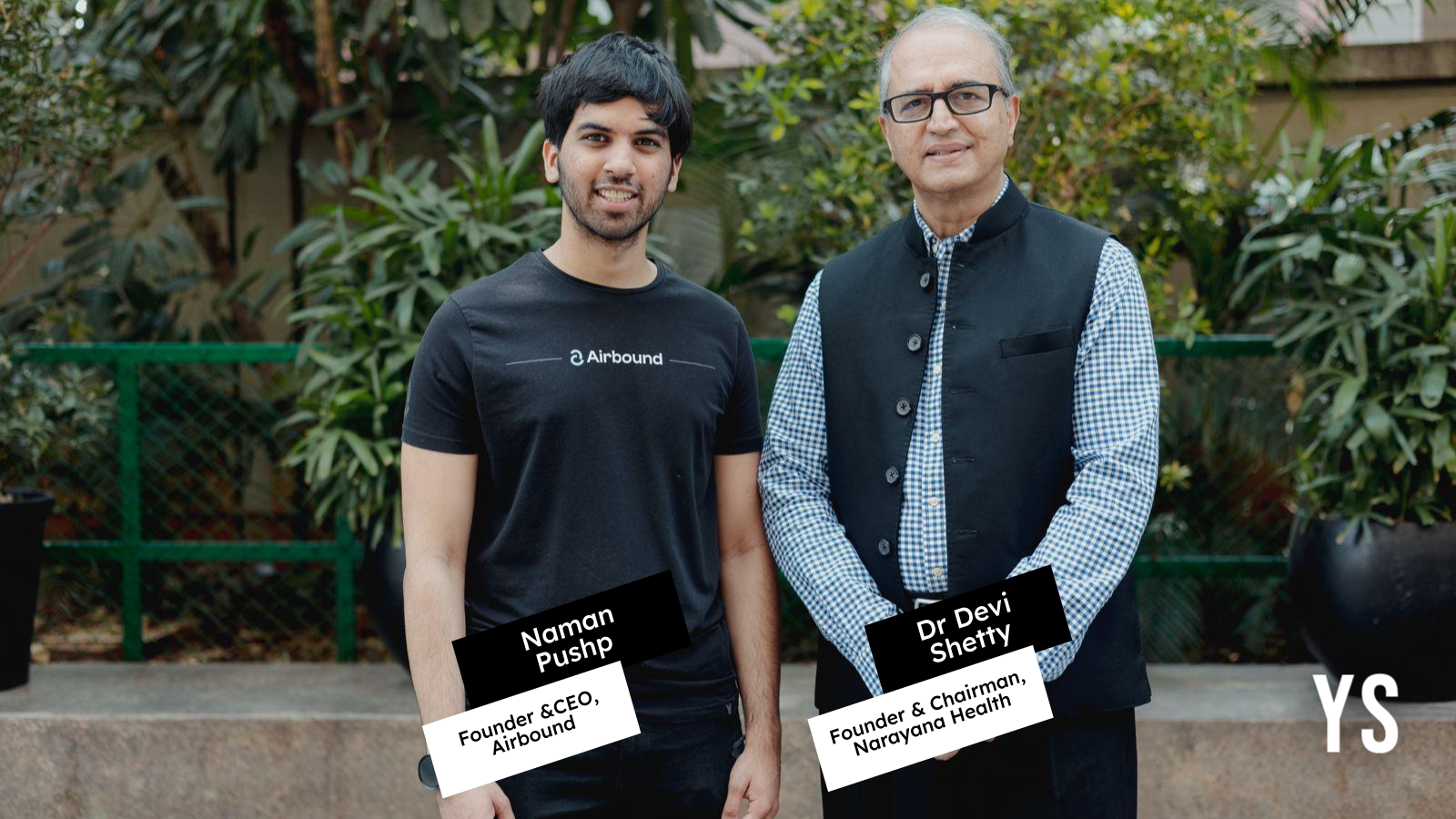
By combining aerospace engineering with digital centralisation, Narayana Health and deeptech startup Airbound are working to prove that quality medical care can be available to everyone.
Traditionally, logistics has been human-centric, meaning that even a small blood sample requires a person and a vehicle to move it.
Airbound is challenging this by developing a blended-wing-body tailsitter drone. This specific design is of an aircraft that takes off vertically like a helicopter but flies forward using the aerodynamic efficiency of a traditional plane.
This shift in form is critical for energy efficiency. While a standard quadcopter, a type of drone that uses four rotors (propellers) to fly, requires massive amounts of thrust to stay airborne, the Airbound drone uses far less energy by relying on its wings.
“Our ambition is to build a new layer of infrastructure for commercial freight, and when that change comes, distance stops being a barrier to opportunity,” said Naman Pushp, Founder of Airbound.
To achieve this, the team at Airbound uses carbon-fibre composites, which are ultra-lightweight materials made of thin, strong crystalline filaments of carbon. The startup’s aircraft is so light that it can be lifted with one hand, yet it is designed to eventually carry payloads that exceed its own weight.
The hardware is paired with a radical approach to hospital operations. Narayana Health is launching its new facility in Banashankari, Bengaluru, as a completely paperless and smart hospital, wherein only clinical staff who physically treat patients will work on-site.
All other functions, such as financial services, human resources, and inventory management, will be handled remotely through a digital platform developed by software engineers.
The practical application of these technologies was recently tested in a 54-day pilot programme. This project connected the Narayana Health Chandapura Clinic in Bengaluru to a central laboratory in Electronic City. The aerial route enabled up to 20 flights per day on a four kilometre path, which completely replaced the old batch road model that relied on only three or four transfers daily.
Over the course of the study, the team completed more than 700 flights and carried up to 40 diagnostic samples per flight. There were zero failures, according to Pushp.
This reliability is vital because it allows labs to receive a continuous flow of fresh samples rather than waiting for road couriers to arrive in fixed batches.
“Driven by the conviction that technology is the primary catalyst for reducing healthcare costs, we are proud to announce the expansion of our medical drone delivery services,” noted Dr Devi Prasad Shetty, Founder of Narayana Health.
Following this pilot, the duo are planning to establish a permanent aerial corridor between Electronic City and the new hospital in Banashankari.
The goal is to centralise all laboratory and blood bank services. By processing 25,000 tests a day in one high-volume centre rather than having individual labs in every hospital, the cost per test is expected to drop dramatically while the accuracy improves, according to Dr Shetty.
The broader idea is that the quality of healthcare a citizen receives should not be determined by their bank balance. This vision targets the missing middle, particularly the 400 million workers in the informal sector.
A key part of this strategy is the introduction of health savings accounts, which are dedicated, zero-balance accounts for gig workers and domestic helpers, Dr Shetty said, adding that employers can contribute small amounts to these accounts to cover insurance premiums.
“India will prove to the world that the wealth of the nation or wealth of the family has nothing to do with the quality of healthcare its citizens will enjoy,” remarked Dr Shetty, who believes this model will be transformative.
Pushp highlighted that the startup’s approach uses the internet’s ability to democratise information as a template for democratising physical services. Just as the internet allowed someone in India to work for a company in the United States, these drones aim to provide a villager with the same quality of diagnostic care as someone living in a major city.
By shortening distances and lowering the cost of logistics to less than one rupee per sample, the partnership is building a model where geography will not dictate quality medical care.
Last October, the autonomous delivery logistics firm secured $8.65 million in seed funding to advance its drone-based delivery operations, while also announcing the pilot partnership with Narayana Health.
The tests in Bengaluru are only the beginning, with plans already in place to expand this aerial medical infrastructure to other major cities, including Kolkata.